 Author:
 Reshama Shaikh
With contributions from: Gaël Varoquaux, Andreas Mueller, Olivier Grisel, Julien Jerphanion, Guillaume Lemaitre
Top Line Summary
Sprints are working sessions to contribute to an open source library. The goals and achievements differ between Developer and Community sprints. The long-term impact of open source sprints, particularly community events, is not easily quantifiable or measurable. Positive outcomes of sprints have slowly been emerging, and for that reason, to realize the value of open source sprints requires playing the “long game”.
Introduction
The scikit-learn project has a long and extraordinary legacy of open source sprints. Since 2010, when its first public version was released, there have been as many as 45 sprints organized. The 45 number is a lower bound, since there are likely more sprints that have not been listed.
To date, scikit-learn has over 2300 contributors to the library. The number of contributors to scikit-learn exceeds those of other related libraries such as numpy, scipy and matplotlib, with the exception of the pandas, which has a greater number of contributors (See Appendix A).
The public discourse on open source has expanded to explore topics of sustainability, funding models, and diversity and inclusion, to name a few. A reasonable, yet ”difficult to answer” question that has been posed is:
What is the effectiveness of sprint models and what is the long-term engagement as a result of these sprints?
Due to technological limitations of GitHub, we do not hold precise data on how many scikit-learn contributors connected to the project via a sprint. We have no formal data collection process which records statistics on how many sprint participants are recurring or information on their contributions to other open source projects or other long term positive ripple effects. A scientific look at the correlation between the number of sprints and contributors is beyond the scope of this article. What we will examine in this article are the objectives, results and aspirations of running the scikit-learn open source sprints.
The queries from other open-source projects requesting guidance on sprints and diversity and inclusions have been increasing. We share these experiences and lessons learned with the community, potential funders and open source project maintainers, particularly those projects which are nascent in their quest to build community, sustainability and diversity and inclusion.
Outline
In this article we examine the following:
- What is a “sprint”?
- What are the differences between “Developer” and “Community” sprints?
- What are the goals of the open source sprints?
- What value do open source sprints bring to the project and community?
- What are the aspirations of the scikit-learn project, in terms of connecting with the community?
Definition of Sprint
A sprint has traditionally been an event where contributors come together to work on issues in the scikit-learn repository. A sprint can be as short as a few hours, or last over several days, even a week or longer. They may be in-person, online, hybrid or asynchronous. Sprints may be organized by the developers of the library, community groups (such as Meetups), scheduled alongside scientific or Python conferences, or even at home with a few friends. They can more simply and less dauntingly be described as
working sessions to contribute to the open source library.
Developer vs Community Sprint
We distinguish between a Developer (Dev) and Community sprint because the goals and results differ significantly between the two.
Developer (Dev) Sprint
A Developer, or “dev”, sprint is one that is typically organized by the maintainers of the library. A dev sprint is one where the developers or maintainers of the library gather to work on issues and to discuss the resolution of ongoing complex issues. This also provides the team an opportunity to focus on tasks related to the long-term roadmap of the project.
For scikit-learn, the early sprints were alongside the SciPy conferences and the practice has continued for over a decade.
Community Sprint
A Community sprint can be a collaboration by individuals, by affinity communities such as Meetup Groups (Data Umbrella, PyLadies, etc.), by conferences (SciPy, PyData Global, JupyterCon, etc.). A Community sprint is one that is with the general public and it may be beginners, experts, or a combination of both.
At a Developer sprint, a contributor may work on a PR that has been ongoing for three months. Conversely, Community sprints require curated issues which newcomers can complete in a shorter period of time (such as 1 day, or 1 day with 1-2 months follow-up).
The landscape of community sprints with other scientific python libraries is unknown. It is possible that scikit-learn may have had community sprints earlier than other projects.
Goals of the Sprints
Goals of Dev Sprints
- Get maintainers in one room to efficiently discuss open issues and pull requests
- Move along contributions in a synchronous fashion
- To foster existing collaborations with external developers synchronously (Julien)
- Building rapport: Maintainers reside in various continents and the in-person sprints build rapport within the team. Social interactions are critical in having a productive team
- To foster collaborations with the project’s corporate sponsors (members of the scikit-learn Consortium)
Goals of Community & Beginner Sprints
- To broaden the project’s contributor base
- To build community and connect the project maintainers with its users
- To get interactive feedback from new scikit-learn users and contributors
- To onboard new contributors to scikit-learn and PyData generally
- To onboard new contributors who would become recurring contributors
- To collaborate with community groups to increase diversity of contributor base with intentional outreach
- To increase the number of recurring contributors
scikit-learn Team Members Who Connected to the Project Via a Sprint
It is notable that a number of the current maintainers of the library found their way to the project via a sprint. Additionally, some members of the Contributor Experience Team also connected to the scikit-learn project via the sprints.
Olivier Grisel
Olivier Grisel has been a contributor and maintainer for more than 12 years. Olivier met Gaël Varoquaux at a local conference organized in Paris by the French speaking Python users group AFPy.org. After chatting 5 minutes about toy ML experiments in Python, Gaël invited Olivier to join the first sprint organized at Inria in March 2010:
Olivier shares:
At the time, scikit-learn coding sprints gathered only 6 people sitting around a table with some wifi and a coffee machine :)
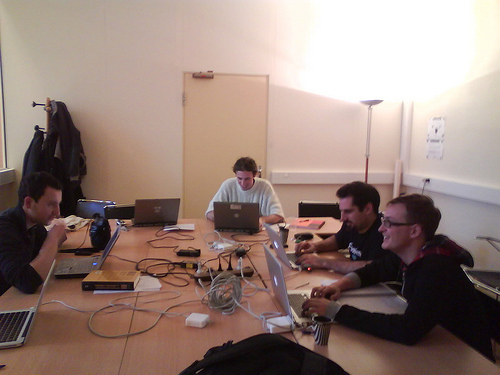 First scikit-learn sprint, Paris, March 2010; Photo credit: Fabian Pedregosa
Andreas Mueller
Andreas Mueller has been a maintainer of the project since 2011. He joined a sprint at a conference because he was a user and wanted to contribute. He shares in a 2017 interview:
While working on my Ph.D. in computer vision and learning, the scikit-learn library became an essential part of my toolkit. My initial participation in open source began in 2011 at the NeurIPS conference in Granada, Spain, where I had attended a scikit-learn sprint. The scikit-learn release manager at the time had to leave, and the project leads asked me to become release manager; that’s how it all got started.
Julien Jerphanion
Julien Jerphanion participated in a sprint in February 2019 at AXA as a first time contributor while interning at Dataiku. The sprint provided Julien an opportunity to experience scikit-learn and meet the maintainers. Prior to the sprint, he had only used the library in a few projects. He contributed code, reviews, and documentation since March 2021, joined Inria in April 2021 and in October 2021, Julien became a core developer.
Other Maintainers
There are other maintainers and emeritus contributors who had participated in a developer or community sprint along their journey with the scikit-learn team, such as Vlad Nicolae (current maintainer), Gilles Loupe (Emeritus), Thouis (Ray) Jones (Emeritus).
Reshama Shaikh
Reshama Shaikh has organized nine scikit-learn community sprints from 2017 to 2021. She first contributed code and documentation fixes to scikit-learn in September 2018. In September 2020, she was invited to join the scikit-learn team.
In her PyConDE PyData Berlin keynote from April 2022, 5 Years, 10 Sprints, a scikit-learn Open Source Journey, she shares a history and progression of the Community sprints.
Juan Martín Loyola
Juan Martín Loyola started contributing to scikit-learn as preparation for the Data Umbrella Latin America, June 2021 sprint. He continued to contribute prolifically after the sprint, and he was invited to join the team in December 2021. Given his location in Argentina, he will be providing support at the 2022 SciPy Latin America sprint.
Second Degree Impact
Lauren Burke joined the scikit-learn Communications Team in November 2021 at the recommendation of Reshama Shaikh, and this can be considered a network effect.
Sprints: Observed Impact and Lessons Learned
There are a number of observed favorable outcomes from the sprints for both the project and contributors.
Onboarding
The sprints help the community discover the open source process and get started with contributing.
Building community
Sprint participants, whether one-time or recurring, become ambassadors for the project.
Open source workflow knowledge
Users learn about testing, control version system (i.e. git), documentation which they bring to their work. The sprint experience assists contributors in developing a wider set of technical skills that can be shared across projects, networking, on to jobs and more.
Overcoming barriers to entry
The sprints, as a “hands-on working session”, provides an avenue for potential contributors to overcome common barriers to entry, particularly “getting started”, and moving from the possibility to an actuality stage.
Providing an avenue for advanced contributions
As sprints provide an on-ramp for new contributors, it similarly provides an opportunity for returning contributors to advance their contributing skills to the next level in a structured environment and with mentorship.
Building confidence
The sprints help to build confidence for both new and returning contributors.
Gaël shares:
I believe those sprints helped resourceful people (like Juan Martín) to gain confidence and provide valuable contributions (especially reviews).
Increase open-source literacy
The sprints are a forum for users to gain a greater understanding of how an open source project functions and for the user/contributor to learn of an actual contribution, from start to finish.
Value of synchronous interaction
Typically, open source contributions to scikit-learn occur on the GitHub repository in asynchronous fashion. The sprints provide real-time synchronous interaction. This experience provides more direct access to technical assistance and feedback to the contributor, and in a direct, efficient, and time-saving manner.
Julien shares:
I think having a setup like this [beginner/community sprint] is valuable for first time contributors because they can synchronously get specific information they would hardly have got otherwise. To me, this allow giving feedback which is immediate, specific and exact, making contributing to open-source enjoyable and preventing frustration: giving such feedback is what we should aim for and in this regard this setup is convenient.
Online Sprints
Since the start of the pandemic, Data Umbrella organized 4 online sprints. Additionally, there were 2 online sprints with SciPy and EuroPython.
These have been the observed benefits of the online sprints, which began in 2020 due to the global pandemic:
Networking
Sprints make it easier to meet new people with different backgrounds, and in particular, online sprints help break geographical barriers.
International collaboration
Collaborating with affinity communities can attract more candidates from various backgrounds.
Pair programming
The pairing of contributors seems to work well. Pair programming was consistently ranked as a positive experience by online sprint participants
Increases accessibility
The use of online tools in particular makes it possible to interact with people who would not have joined traditional community events organized in North America or western Europe e.g. because of the travel costs and complexity to get a visa in time. Attending those online events is probably also less disruptive for people with young children.
For the scikit-learn project itself, it made it possible to “recruit” a couple of new recurring contributors who attend regular office hours after the original sprints.
Office Hours
Actually the fact that we now have community office hours on discord is probably a consequence of us attending the Data Umbrella online sprints.
Olivier shares:
I think they [the sprints] were the most interesting online events I attended during the COVID-19 crisis when all traditional on-site tech events were canceled. In particular the active planning by the Data Umbrella team for participants to work in pairs with audio rooms on Discord + a central help desk audio room worked really well.
The pre-sprint and post-sprint office hours also made it possible to limit the time spent on helping fix setup issues compared to what we experience in traditional sprints. They also forced us as maintainers to review and fix our documentation before the event.
Creation of supplementary resources in various medium forms
Data Umbrella coordinated the creation of a series of videos and transcripts that provided learning materials for the community to prepare for the sprint. These resources were available to the public and have a wide reach:
This is the Contributing to scikit-learn list of videos that were created for the sprints.
- Andreas Mueller: Crash Course in Contributing to scikit-learn
- Reshama Shaikh: Example of scikit-learn Pull Request
- Andreas Mueller: Sprint FAQs
- Thomas Fan: 3 Components for Reviewing a Pull Request
- Melissa Weber Mendonca: Sphinx for Python Documentation
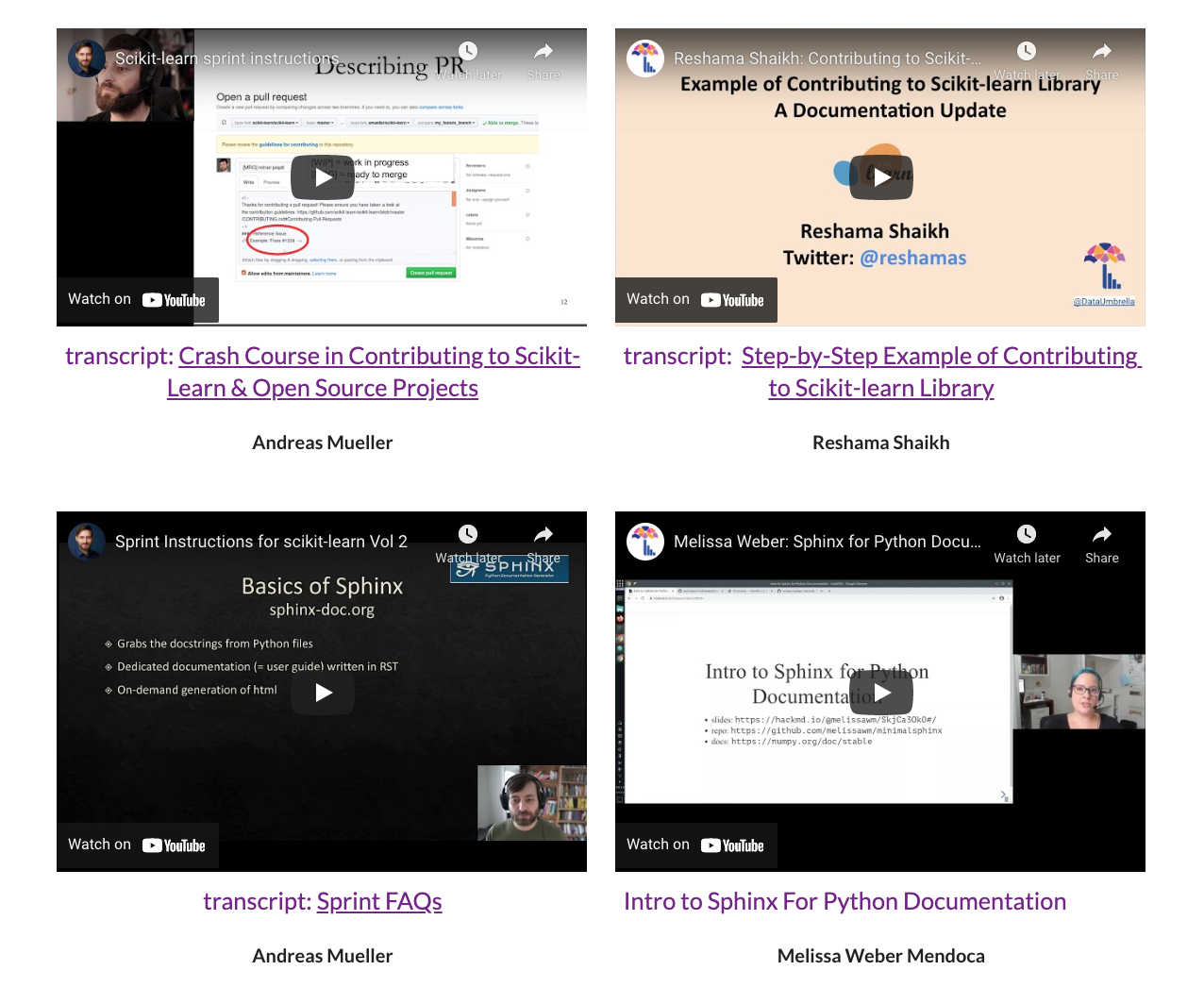 Photo credit: Reshama Shaikh
Aspirations for Future scikit-learn Sprints
One of the primary goals of the Community sprints was to onboard new contributors who would become recurring contributors. This goal has generally not been realized. scikit-learn is a complex and advanced project, and a one-time sprint does not provide sufficient opportunity and support to sprint participants to become recurring contributors. A few sprint participants have progressed to become returning contributors, and it is a very small number relative to the number of sprint participants.
Onboarding a first-time contributor takes time. People who are contributing for the first time need to go through a lot of information simultaneously regarding both technical and organizational aspects of contributions. People may run into unexpected issues at the really start depending on their setup and experience, might get frustrated and or discouraged and might not report the problem they are having (thinking it is their fault). Pre-event office hours have been successful at alleviating some of these roadblocks, for those sprint participants who have completed their pre-work.
Here are some adjustments that can be made in the future to reach the goal of recruiting recurring contributors:
- Provide mentoring
- Improve onboarding process
- Improve issues definitions
- Have sprints alongside tutorials
- Expand types of contributions that new contributors can make
- Have smaller sprint events
Mentoring
Sprints may not be sufficient for onboarding people. Mentoring is needed to take to the next level. Mentoring relationships can be established during sprint events.
Improve the onboarding process
While the scikit-learn project has improved significantly in the past few years as a result of feedback and learnings from the sprints, there is still room for improvement.
The scikit-learn project is complex, the contributor learning curve is steeper, and it has been getting more difficult to contribute to scikit-learn.
Improve issues definitions
There are 1600+ issues in the GitHub repository. Issues can be better defined and it would be valuable to break the issues into smaller steps which would be more approachable.
Sprints alongside tutorials
Scheduling sprints alongside tutorial sessions would be conducive in allowing users to connect the open source tool use cases with the motivation and product vision of scikit-learn.
Expand types of contributions
While the sprints have typically focused on documentation and code contributions, the project needs support in other areas. There is a backlog of open issues (1600+ !) and open pull requests (650+). The project needs support in triaging issues and reviewing pull requests. It would be beneficial to have sprint contributors work on increasingly complex issues.
Julien shares from personal experience:
In particular and in my opinion,reviewing pull requests is as valuable as authoring them. I also find it a preferable way to learn about scikit-learn internals rather than solving issues.
Have smaller sprints
Julien suggests:
Would sprints with a really small number of people (e.g. 2 mentees per mentor) be more valuable in the long term? Personally, I would prefer mentoring one or two people closely instead (ideally in-person) as I think it is more achievable, enjoyable and fruitful experience (this is something I am trying to do at the moment when I can get some time but I currently have limited of it).
Finally, I would also really treasure having in-person sprints [in Paris] with external (recurring) contributors (with a specific expertise) on advanced subjects when it is possible in the future.
Appendix A: GitHub Contributors Comparison of Libraries
A comparison of the contributor base to other related libraries in the same space (May 2022):
- pandas: ~2560
- scikit-learn: ~ 2300 contributors
- numpy: ~ 1300 contributors
- matplotlib: ~1150
- scipy: ~1120